
Introduction
B2B search is evolving past traditional search engine results. Buyers use AI tools to research vendors, compare solutions, learn about industry challenges, and build shortlists before contacting sales teams. This shift is changing how B2B companies create content, manage SEO, and drive digital demand.
Traditional SEO focuses on improving rankings, organic traffic, and click-through rates. AI search optimization takes it a step further by making your content a trusted source for AI-generated answers, summaries, recommendations, and citations. To achieve this, businesses should organize information clearly, demonstrate expertise, provide evidence, and answer buyer questions accurately.
This shift creates new opportunities for companies using B2B content syndication. High-quality content can increase visibility on publisher sites, industry platforms, and other digital channels. Keeping your content library well-organized also helps AI systems recognize your brand’s expertise.
The challenge today isn’t just about getting your content found. It’s about making sure it’s useful, trustworthy, easy to access, and recognized as an authority when AI systems answer complex B2B questions.
1. Understand How AI Search and Answer Engines Retrieve Information
AI search platforms use different methods to generate answers. Depending on the platform, these might include web retrieval, semantic search, large language models (LLMs), source ranking, and retrieval-augmented generation (RAG).
With retrieval-augmented generation, the system gathers relevant information from sources to create a response. Content is selected if it matches the user’s intent, provides useful evidence, explains ideas clearly, or adds helpful details to other sources.
This approach is different from basic keyword matching. For example, a page that only targets the phrase ‘B2B marketing automation’ is less helpful than a detailed guide explaining how to implement it, what integration is needed, key performance metrics, and common technical issues.
B2B marketers should focus on three main goals:
-
Discoverability: Ensure search engines and supported AI crawlers can access the content.
-
Retrievability: Organize information so relevant sections can be identified and understood.
-
Citation potential: Provide original, accurate, and well-supported information that makes the page useful as a source.
These goals build on traditional SEO rather than replace it. Search visibility, technical access, relevant topics, and content quality remain essential.
2. Build Content Around Buyer Intent and Conversational Queries
People using AI search often ask detailed questions instead of just typing short keywords. B2B buyers might ask which solution fits their company, how options compare, what implementation involves, or which vendors meet specific technical needs.
Content strategies should shift from focusing on single keywords to organizing information around what buyers really want to know.
G2’s 2025 Buyer Behavior Report found that 79% of B2B software buyers say AI search has changed how they research. The report also says AI chatbots now top vendor shortlists.
This makes it important to create content that addresses the full decision-making process, from identifying the problem to evaluating solutions.
Practical optimization techniques include:
-
Map keywords to search intent: Group informational, commercial, comparison-based, and implementation-related queries into topic clusters.
-
Use question-led headings: Structure H2 and H3 headings around the actual questions prospects ask.
-
Answer questions directly: Introduce each section with a concise answer before expanding into technical details.
-
Cover follow-up questions: Explain prerequisites, benefits, limitations, costs, use cases, and evaluation criteria where relevant.
-
Build connected topic clusters: Link supporting articles to comprehensive guides and relevant service pages.
For example, a page about B2B content syndication should explain how the process works, how it’s different from content distribution, how leads are qualified, and how campaign performance is measured. These connected explanations help readers understand the topic and create a stronger structure.
3. Strengthen Content Credibility with Original Data and Verifiable Evidence
AI systems need valuable source material to generate informative responses. If your content only repeats widely available information without adding real insight, readers have little reason to trust or return to your site.
B2B marketers should focus on evidence-based content that shows first-hand expertise, industry knowledge, and clear reasoning.
Useful evidence includes:
-
Original surveys, research findings, and industry benchmarks.
-
Case studies with clearly defined objectives, methods, and outcomes.
-
Technical explanations supported by credible documentation.
-
Expert commentary that explains why a trend matters.
-
Comparisons that disclose evaluation criteria and limitations.
-
Recent statistics accompanied by their source, publication date, and relevant context.
For example, a blog about content syndication could explain how lead-qualification criteria impact campaign results, using anonymized data when possible. This makes your resource stand out compared to a generic overview of content distribution.
Brand credibility also extends beyond the website. Gartner reported in May 2026 that 45% of surveyed B2B buyers had used generative AI, primarily to research vendors and products, while 69% preferred validating AI-generated insights with sales representatives.
This point matters: AI-assisted discovery doesn’t remove the need for trusted evidence or human expertise. Marketing content should help buyers evaluate solutions on their own and give sales teams credible material to support those claims.
4. Apply Technical SEO and Structured Content Principles
Even the best content won’t help your search visibility if crawlers can’t access it or if key information is hard to find.
Google’s official guidance confirms that existing SEO fundamentals remain relevant to AI features, including crawlability, indexability, internal linking, accessible text, and helpful content. It also states that there are no additional technical requirements specifically for inclusion in Google AI Overviews or AI Mode.
B2B websites should focus on these technical steps.
Improve crawlability and indexability
Review robots.txt, XML sitemaps, canonical tags, HTTP responses, and indexing directives. Confirm that important service pages, blogs, case studies, and research assets are accessible to the relevant crawlers.
Make sure important content is available as readable text, not just inside images, scripts, or downloadable files.
Use a logical heading hierarchy
Set up each page with a clear H1, useful H2 sections, and H3 subsections as needed. Use short paragraphs, clear lists, and tables to make technical details easier to follow.
Implement relevant structured data
Use the right Schema.org types, like Article, Organization, BreadcrumbList, and Person, when your page supports them. Make sure your structured data matches what’s on the page and follows search engine guidelines.
Structured data can clarify entities and page information, but it does not guarantee AI citations or special search placement.
Strengthen internal linking
Link related blog posts, service pages, case studies, and resource hubs with clear anchor text. This helps readers find what they need and helps search engines understand how your pages are connected.
Maintain a strong page experience
Make sure your pages load quickly, work well on both mobile and desktop, and let users access key information without annoying pop-ups or extra navigation steps.
5. Optimize Content for Answer Extraction and Citation
Answer engine optimization (AEO) focuses on making information easy to identify, interpret, and use when responding to a query. Generative engine optimization (GEO) extends this approach to visibility within AI-generated responses.
Neither method guarantees your page will be cited. Still, clear writing, strong evidence, and well-structured explanations make your content more useful for both people and AI systems.
Apply these practices to key website pages:
Start with the answer. Begin each main section by directly answering the question, then add supporting evidence, examples, and technical details.
Define industry terminology. Explain concepts such as intent data, buying group intelligence, lead scoring, and content syndication when they first appear.
Use comparison tables where appropriate. Present differences between methodologies, tools, and service models using consistent criteria rather than vague claims.
Make sure your claims are clear on their own. Don’t use phrases like “this approach” or “the above method” without saying exactly what you mean. Keep important context close to the statement it supports.
Add helpful FAQs. Answer real buyer questions about implementation, suitability, performance measurement, and limitations. Make sure your FAQs offer real value instead of just repeating keywords.
For example, a useful FAQ might be: How does a B2B content syndication service support demand generation?
A direct answer could explain how a B2B content syndication service distributes relevant content through third-party channels to reach prospective buyers, generate responses, and support lead acquisition. The answer can then clarify how targeting, qualification, consent, and lead validation influence campaign quality.
This approach helps both potential customers and readers who want quick, specific answers.
6. Integrate Content Syndication with AI Search Visibility
Publishing an article on your company website is just one part of a complete visibility strategy. B2B organizations also need to reach the right audiences through trusted external platforms, industry publications, professional communities, and partner channels.
A well-planned B2B content syndication strategy can help your research reports, technical guides, white papers, and expert articles reach beyond your own channels.
Carefully manage the connection between syndication and AI search. Syndicating an article won’t automatically boost AI citations, and having duplicate copies on different sites doesn’t guarantee more authority. The real value comes from reaching the right audience, publishing on credible sites, sharing high-quality content, and making sure the pages are easy to access.
A practical approach involves four steps:
-
Create an authoritative source asset. Publish the original research, guide, or article on your website, supported by clear authorship and evidence.
-
Identify relevant distribution partners. Select publishers and platforms whose audiences align with your target accounts and industry.
-
Adapt content to the channel. Create original summaries, commentary, and supporting resources rather than indiscriminately reproducing identical material.
-
Measure engagement and downstream outcomes. Track referral traffic, qualified leads, target-account engagement, and assisted pipeline contribution.
A specialist B2B content syndication service can help with audience targeting, distribution planning, lead qualification, and campaign reporting.
To improve your connection with AI search, keep your brand information consistent and accurate on your website and in external publications. Make sure your product descriptions, service claims, industry expertise, and company positioning all match up.
7. Measure AI Search Performance Beyond Organic Rankings
Traditional SEO metrics are still helpful, but they don’t fully capture your visibility in AI-assisted discovery.
A more comprehensive measurement framework should include:
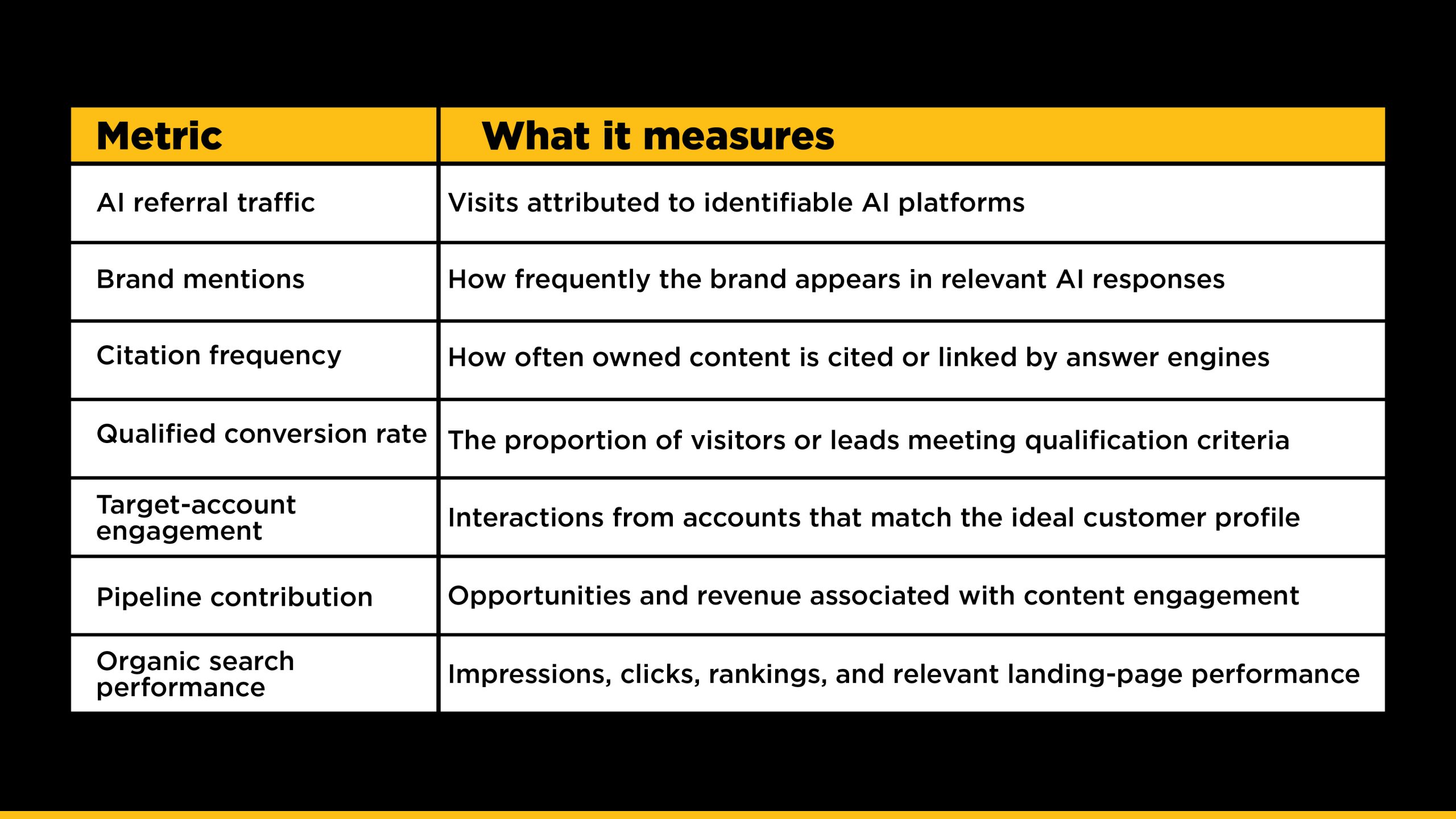
Measuring AI visibility takes extra care. Responses can vary by query, location, user context, platform, or date. Referral analytics might also miss some AI-assisted journeys if users go straight to your website or use another channel afterward.
Establish a repeatable testing process by selecting a set of high-value buyer queries, recording brand mentions and cited sources, and reviewing results at regular intervals. Compare performance across relevant competitors and track whether content changes correspond with improved visibility or business outcomes.
Avoid treating citation counts alone as proof of commercial impact. The goal is to link discoverability to qualified engagement and revenue.
8. Build a Sustainable AI Search Content Strategy
AI search optimization should be an ongoing process of improving your content, not a one-time SEO project.
Begin by reviewing your existing pages for relevance, accuracy, technical accessibility, and any unanswered buyer questions. Look for key articles that could be improved with new research, clearer explanations, better internal links, or updated evidence.
Next, prioritize content based on commercial intent. Service pages, solution comparisons, industry guides, and case studies are great places to answer buyer questions, as they help buyers evaluate options and establish shared ownership across SEO, content marketing, demand generation, and sales. This ensures that content reflects real customer questions, supports consistent positioning, and contributes to measurable marketing outcomes.
Google’s guidance on generative AI content also emphasizes quality, originality, accuracy, and relevance over producing large volumes of pages without meaningful added value.
Conclusion
Optimizing B2B content for AI search and answer engines requires a combination of traditional SEO, intent-led content development, technical accessibility, credible evidence, and consistent brand communication.
The strongest strategies focus on thoroughly answering buyer questions, demonstrating genuine expertise, and creating content that stays useful across multiple discovery channels. Integrating these principles with a targeted B2B content syndication strategy can expand audience reach while supporting a more connected demand-generation approach.
For B2B organizations, the long-term objective is not simply to appear in an AI-generated answer. It is to become a credible, recognizable source of information that helps buyers understand their challenges, evaluate potential solutions, and make informed purchasing decisions.

Add a Comment