Traditionally, B2B marketing success was measured by lead volume. A larger database signaled a successful campaign. However, this approach is now becoming obsolete.
According to Gartner, 75% of B2B buyers now prefer a sales-rep-free buying experience for at least part of their purchasing journey, choosing instead to conduct extensive independent research before speaking with a vendor. Simultaneously, buying committees have expanded, with the average B2B purchase involving six to ten stakeholders, each bringing different priorities and evaluation criteria.
This shift requires organizations to rethink demand generation. Buyers now follow a non-linear path, using multiple channels, researching independently, comparing competitors, consulting peers, and revisiting vendors before deciding. Marketers must adapt to this complex journey.
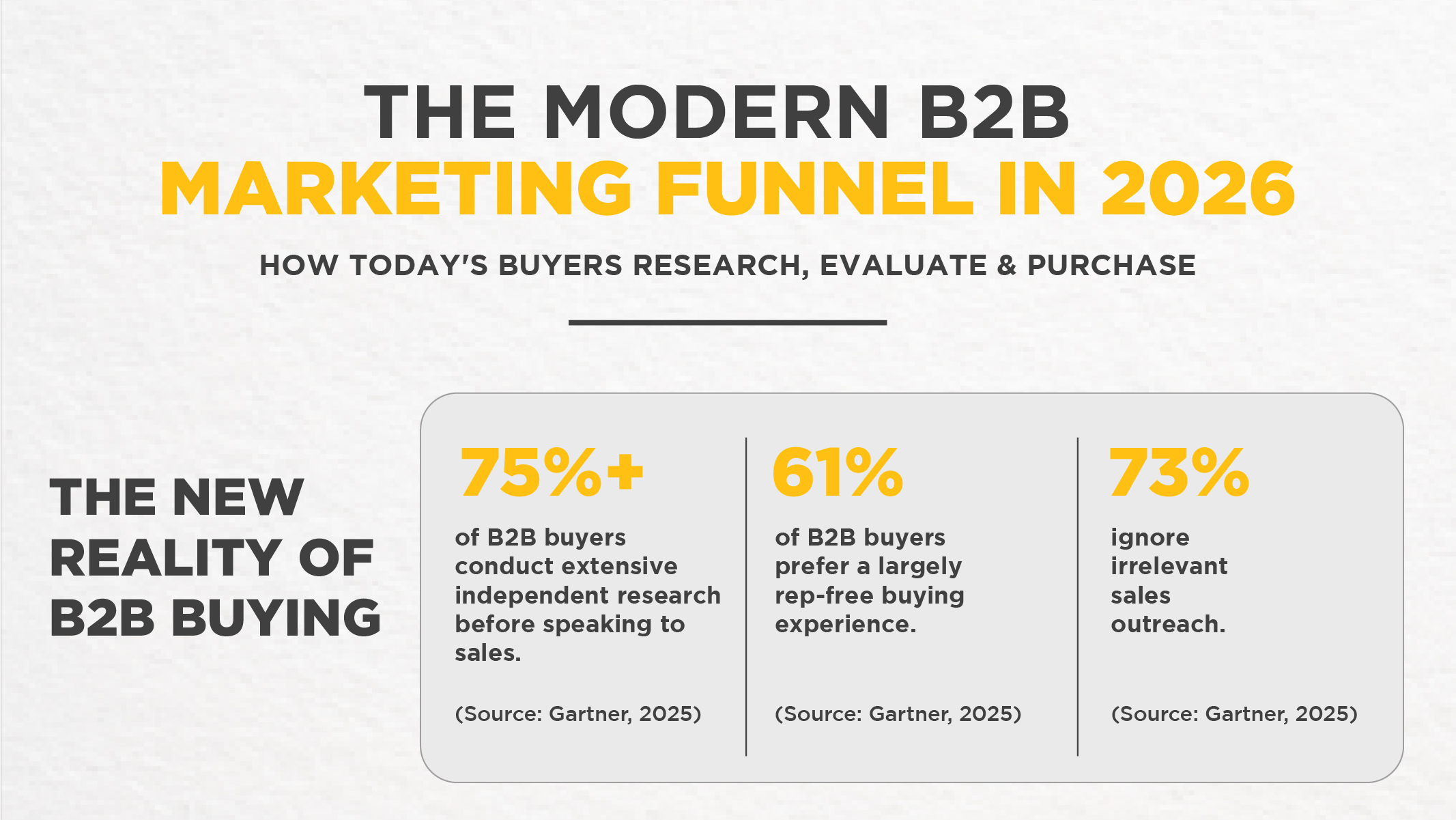
Modern B2B marketing now prioritizes attracting the right accounts, nurturing them with relevant content, and guiding them through each stage of the buying journey. Success depends on a buyer-centric funnel focused on quality, engagement, and revenue rather than lead volume.
B2B marketing and demand-generation agencies must now create buyer-centric funnels that emphasize quality, engagement, and revenue over vanity metrics.
The Modern B2B Funnel Has Changed
Traditional marketing funnels followed a straightforward path:
Awareness → Interest → Consideration → Purchase
Today’s buyer journey is far more dynamic.
Prospects frequently move backward and forward between stages, revisit previous research, seek third-party validation, and compare multiple vendors simultaneously. Research from Forrester suggests that buyers may complete over 70% of their evaluation process before initiating direct conversations with suppliers.
As a result, marketers have fewer direct opportunities to influence purchasing decisions.
Therefore, every interaction, whether a blog, webinar, LinkedIn post, industry report, or case study, must deliver genuine value and address buyers’ immediate questions.
Four Factors That Drive Buyer Progression
Understanding how buyers move through the funnel helps marketers create more effective campaigns at each stage.
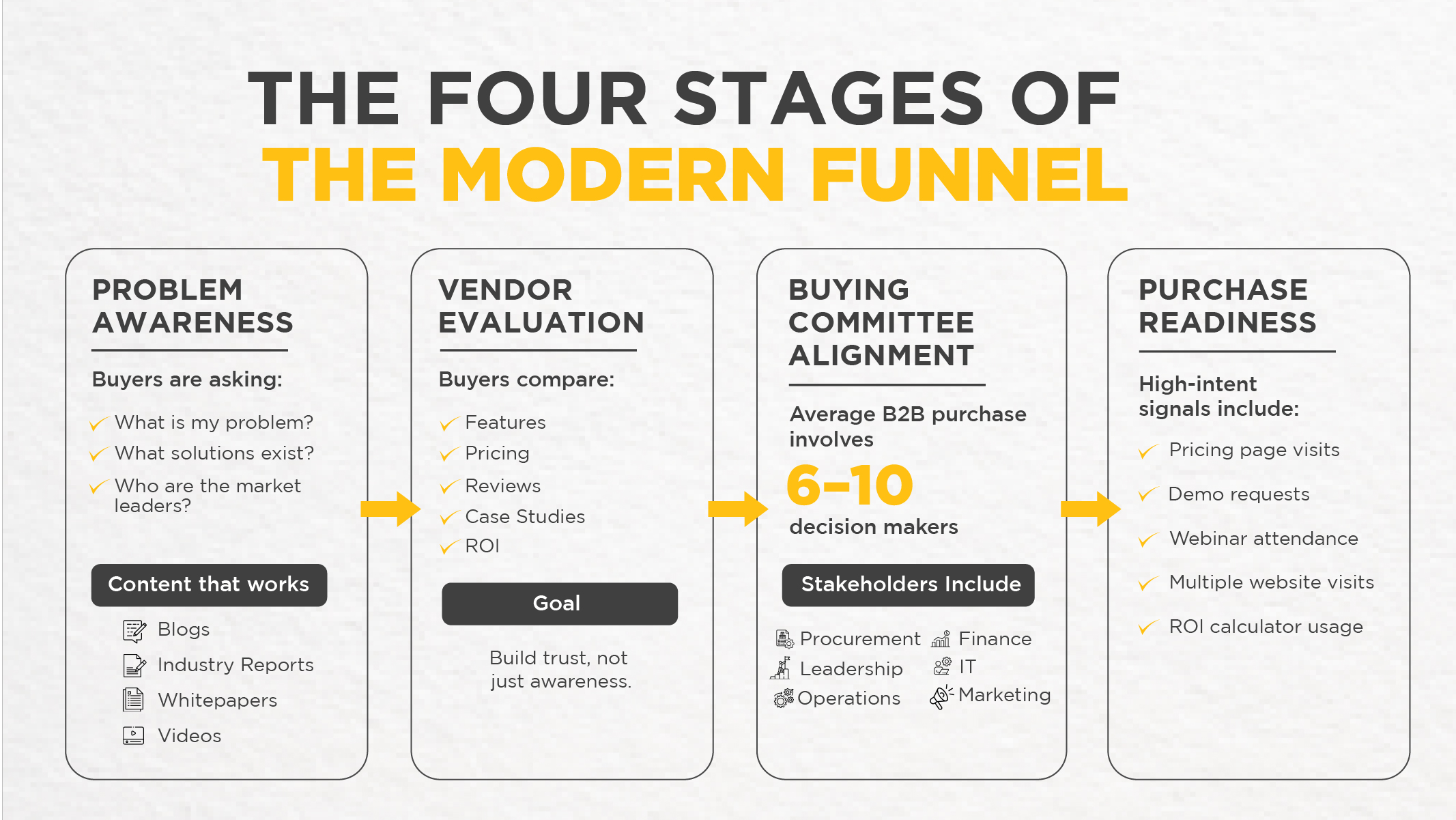
1. Problem Awareness and Solution Research
Every purchase begins with a business problem.
Buyers first seek to understand:
-
Why the problem exists
-
How similar organizations solve it
-
Which technologies are available
-
What risks arise from delaying action
Google reports that B2B buyers conduct numerous online searches before contacting suppliers and consume educational content from multiple sources throughout the process.
At this stage, educational resources are more effective than promotional messaging.
Examples include:
-
Industry blogs
-
Research reports
-
Whitepapers
-
Explainer videos
-
Infographics
-
Benchmark reports
Immediate conversion is not the goal at this stage.
Marketers should focus on building credibility by helping buyers understand their challenges.
2. Vendor Evaluation and Comparison
Once buyers recognize possible solutions, they begin comparing providers.
Trust becomes critical at this stage.
Prospects evaluate:
-
Industry expertise
-
Customer success stories
-
Product capabilities
-
Implementation support
-
Pricing models
-
Technical documentation
-
Independent reviews
According to TrustRadius research, buyers increasingly rely on peer reviews and third-party validation before making purchasing decisions.
Helpful content during this phase includes:
-
Product comparison guides
-
ROI calculators
-
Customer testimonials
-
Interactive demos
-
Case studies
-
Frequently asked questions
Each asset should reduce uncertainty and demonstrate measurable business value.
3. Buying Committee Engagement
B2B purchases rarely involve one decision-maker.
The average buying committee often includes:
-
Marketing leaders
-
Finance executives
-
IT specialists
-
Procurement teams
-
Department managers
-
Senior leadership
Each stakeholder evaluates the solution differently.
For example:
A Marketing Director focuses on campaign performance.
A Chief Financial Officer examines commercial return.
An IT Director prioritizes integration, security, and scalability.
Procurement teams evaluate contracts and compliance.
Effective demand generation requires content tailored to each stakeholder, not a generic message.
4. Commercial Intent and Purchase Readiness
Eventually, prospects begin demonstrating clear buying signals.
These may include:
-
Requesting pricing
-
Booking demonstrations
-
Visiting pricing pages
-
Downloading implementation guides
-
Returning repeatedly to the website
-
Engaging with sales emails
At this stage, speed is crucial, and marketing and sales must align to deliver personalized follow-up and maintain momentum.
Alignment between marketing and sales is essential for effective, personalized follow-up.
Companies that respond quickly to high-intent prospects often achieve significantly higher conversion rates than those that rely on delayed outreach.
Why Lead Volume Is No Longer the Primary KPI
Large databases can create a false sense of marketing success.
However, thousands of unqualified contacts rarely lead to predictable revenue.
Today’s marketing teams increasingly prioritize metrics such as:
-
Marketing Qualified Accounts (MQAs)
-
Sales Qualified Leads (SQLs)
-
Pipeline contribution
-
Account engagement
-
Opportunity creation
-
Revenue influenced
-
Customer acquisition cost
-
Lifetime customer value
These indicators provide a more accurate measure of marketing effectiveness than raw lead volume alone.
Content Is the Engine of Funnel Progression
Content is now a primary driver of buyer movement through the funnel, with each stage requiring a distinct format.
Each stage requires a unique content format.
Awareness
-
Educational blogs
-
Industry reports
-
Social media insights
-
Podcasts
-
Infographics
Consideration
-
Whitepapers
-
Comparison guides
-
Case studies
-
Webinars
-
Solution briefs
Decision
-
Product demonstrations
-
Customer success stories
-
Pricing resources
-
ROI assessments
-
Technical documentation
Delivering relevant information at each stage builds buyer confidence and shortens the buying cycle.
Data and Intent Should Shape Every Campaign
Modern marketers no longer rely only on demographics.
Behavioral signals offer deeper insights.
These include:
-
Content downloads
-
Website visits
-
Webinar participation
-
Search behavior
-
Topic engagement
-
Email interactions
Intent data allows marketers to prioritize accounts actively researching relevant solutions instead of treating all leads equally.
This results in:
-
Better lead qualification
-
Improved sales productivity
-
Higher conversion rates
-
Reduced acquisition costs
Instead of increasing campaign volume, organizations should focus resources on prospects showing genuine purchase intent.
Leveraging Predictive Analytics to Improve Funnel Conversion
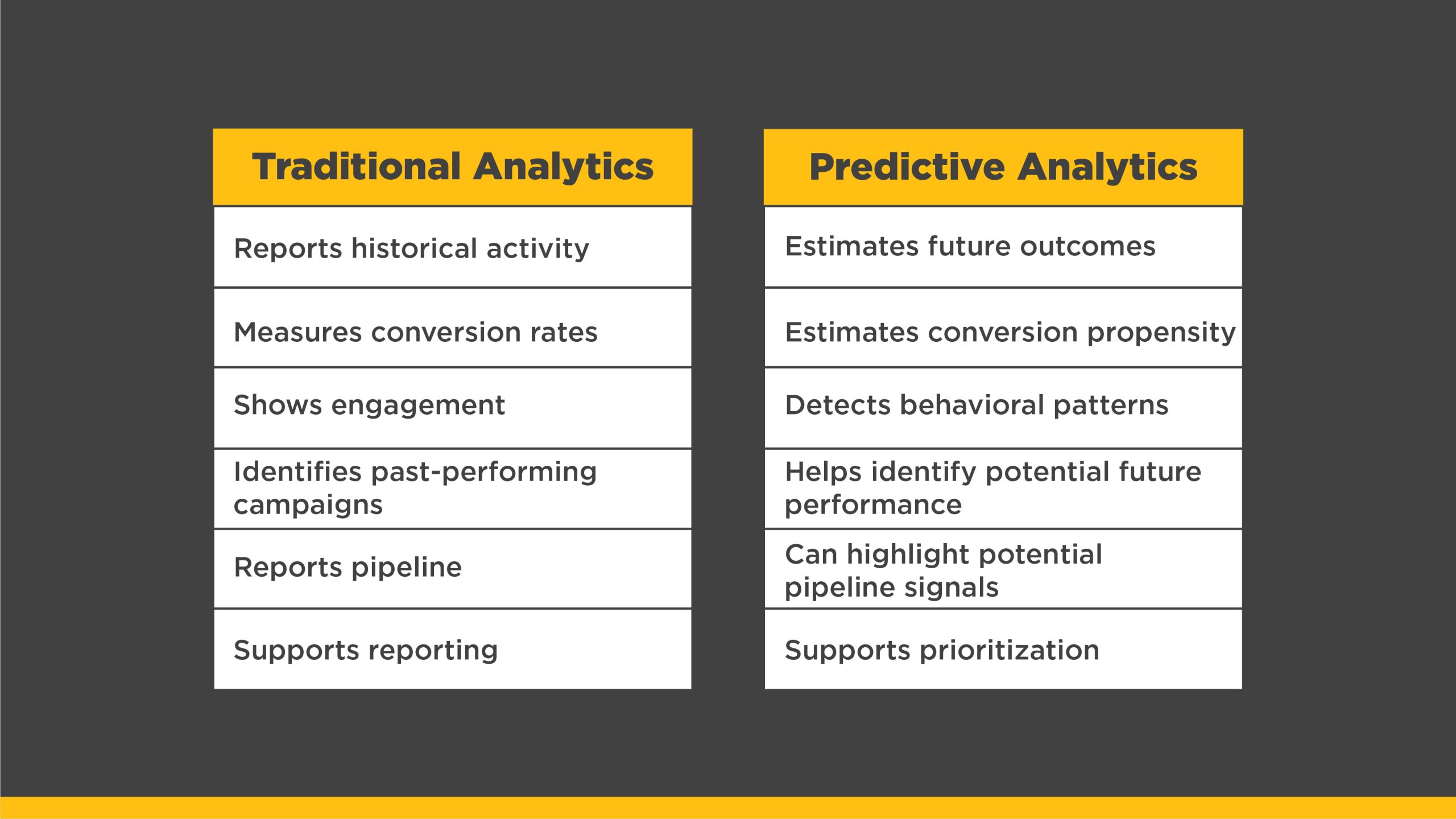
Traditional funnel management often relies on historical campaign performance and predefined lead-scoring rules. Predictive analytics enhances this process by identifying patterns in account behavior, engagement history and conversion data to estimate which prospects are more likely to progress towards a purchase.
By analyzing signals such as repeat website visits, content consumption, webinar participation and engagement from multiple stakeholders, marketers can prioritize accounts demonstrating stronger buying potential. These insights also help identify prospects who require further nurturing rather than immediate sales outreach.
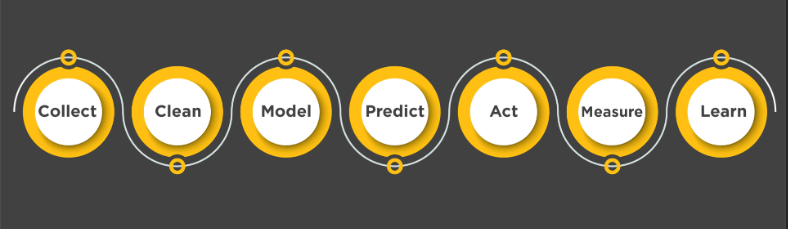
Predictive analytics becomes particularly valuable when integrated with marketing automation and customer relationship management systems. Campaigns can be adjusted according to account readiness, while sales teams can focus their efforts on opportunities with stronger qualification signals.
However, predictive models are only as reliable as the data supporting them. Organizations should regularly evaluate scoring accuracy, update qualification criteria and incorporate sales feedback. This ensures that technology supports informed decisions instead of creating unnecessary complexity in the marketing funnel.
The Best Platforms for B2B Marketing
Selecting the right channels is as important as creating compelling content. Channel choice must align with audience, industry, and buying stage.
The most effective B2B marketing platforms depend on audience, industry, and buying stage, though some consistently deliver strong results.
LinkedIn remains the leading platform for professional networking and B2B demand generation.
Its advanced targeting capabilities allow marketers to reach decision-makers by job title, company size, industry, and seniority.
Sponsored content, thought leadership, and employee advocacy drive engagement among enterprise buyers.
Email Marketing
Despite new channels, email remains one of the highest-performing B2B marketing tools.
Personalized nurture campaigns consistently outperform generic promotional emails by delivering content aligned with buyer interests.
Webinars
Interactive webinars educate prospects and answer questions in real time.
They are especially valuable during the consideration stage, when buyers seek deeper product understanding.
Search Engines
Organic search remains critical because buyers actively search for solutions throughout their research journey.
High-quality educational content enables organizations to capture demand before prospects contact sales.
Industry Publications
Publishing thought leadership on respected industry websites increases credibility and expands brand visibility with targeted audiences.
Combining these channels creates a consistent buyer experience across multiple touchpoints and through every stage of the journey.
Integrating Marketing Platforms for a Unified Buyer Journey
B2B buyers interact with multiple channels before making a purchasing decision. However, when marketing platforms operate independently, organizations often struggle to connect these interactions and understand the complete buyer journey. Integrating CRM systems, marketing automation tools, analytics solutions and advertising platforms helps create a unified view of account engagement.
The best platforms for b2b marketing should support seamless data integration, audience segmentation, campaign orchestration and performance measurement. For example, combining website analytics with CRM data can help marketers identify accounts that repeatedly engage with specific service pages. Marketing automation can then trigger relevant follow-up campaigns, while sales teams receive contextual insights to support timely outreach.
This integrated approach reduces data silos and enables marketing teams to deliver consistent messaging across channels. More importantly, it connects campaign activity with account progression, helping organizations identify which interactions contribute to qualified opportunities and pipeline growth.
Marketing and Sales Must Operate as One Team
One of the largest barriers to funnel performance remains organizational misalignment.
Marketing focuses on generating engagement.
Sales focuses on closing revenue.
Without shared objectives, valuable opportunities are frequently lost.
High-performing organizations establish:
-
Shared revenue goals
-
Unified qualification criteria
-
Common reporting dashboards
-
Regular feedback loops
-
Integrated CRM systems
According to HubSpot’s recent State of Marketing research, organizations with strong sales and marketing alignment generate significantly better customer retention and revenue growth than those operating in silos.
Why Businesses Partner with a B2B Marketing and Demand Generation Agency
Building a high-performing demand generation strategy requires specialized expertise, advanced technology, and continuous optimization.
An experienced b2b marketing and demand generation agency helps organizations:
-
Define ideal customer profiles.
-
Develop buyer-centric content strategies.
-
Identify high-intent accounts
-
Build multi-channel campaigns
-
Align marketing with sales.
-
Measure pipeline performance
-
Improve marketing ROI
Rather than focusing solely on lead generation, agencies help businesses build sustainable revenue engines that consistently attract and convert qualified prospects. For organizations seeking stronger growth, the priority is clear: create a buyer-centric engine that unites content, data, and sales around revenue. The clear takeaway is that revenue growth comes from quality, alignment, and consistent progression through the funnel.
Building a Revenue-Focused Marketing Technology Stack
A successful B2B marketing technology stack should be designed around business objectives rather than the number of tools an organization adopts. Adding multiple platforms without a clear integration strategy can increase costs, fragment data and complicate campaign measurement.
Businesses should evaluate their technology requirements across four core capabilities:
-
Audience intelligence:Identifying ideal customer profiles, target accounts and relevant buying signals.
-
Campaign execution:Managing email marketing, paid advertising, content distribution and account-based campaigns.
-
Performance analytics:Tracking engagement, conversion rates, pipeline contribution and marketing ROI.
-
Sales alignment:Connecting marketing activities with CRM workflows, qualification criteria and opportunity management.
When evaluating the best tools for their requirements, B2B marketers should prioritize interoperability, data quality, scalability and reporting capabilities. The objective is to create a connected ecosystem in which insights inform campaign decisions and campaign outcomes improve future targeting.
Regular technology audits can further identify overlapping tools, underused capabilities and integration gaps. By aligning platform selection with measurable revenue goals, organizations can build a more efficient marketing operation that supports sustainable pipeline growth.
Measuring Success Across the Funnel
Effective demand generation extends beyond campaign metrics.
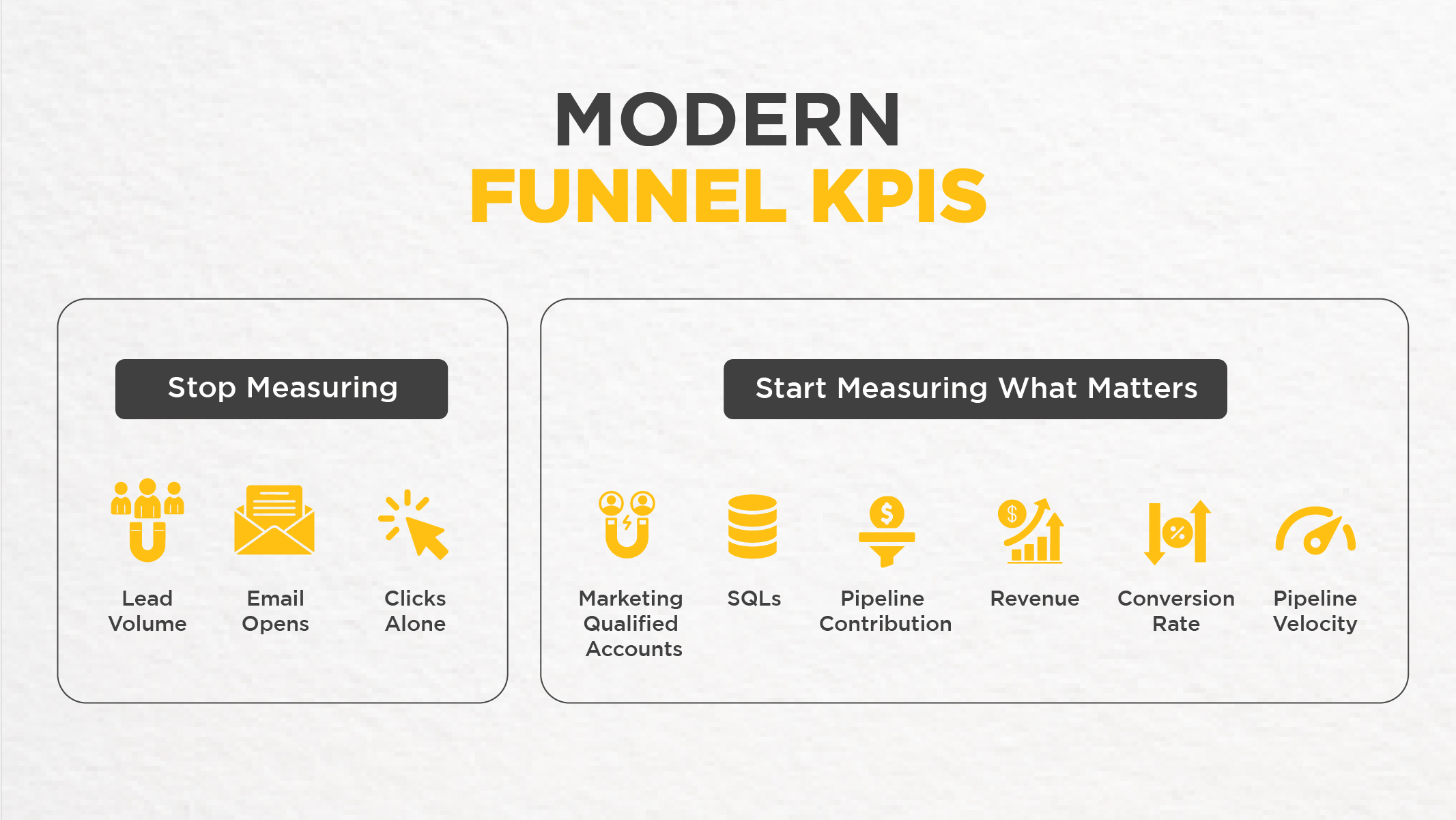
Modern marketers should monitor:
-
Website engagement
-
Content consumption
-
Marketing Qualified Accounts
-
Sales acceptance rates
-
Pipeline velocity
-
Opportunity creation
-
Conversion rates
-
Revenue contribution
-
Customer retention
-
Return on marketing investment.
These metrics provide a comprehensive understanding of how marketing contributes to business growth.
Final Thoughts
The B2B buying journey has become increasingly self-directed, research-intensive, and collaborative. Buyers expect valuable insights long before they engage with a salesperson, making content, personalization, and strategic demand generation more important than ever.
Organizations that continue to measure success solely by lead volume risk overlooking the metrics that truly drive revenue. Instead, the focus should be on understanding buyer intent, engaging decision-makers with relevant content, and guiding high-value accounts through every stage of the funnel.
By leveraging the best B2B marketing platforms, aligning sales and marketing teams, and partnering with a trusted B2B marketing and demand generation agency, businesses can build a stronger, more predictable pipeline that converts prospects into loyal customers. In today’s competitive landscape, sustainable growth comes not from generating more leads but from creating meaningful buyer experiences that inspire confidence, accelerate decisions, and deliver long-term business value.