
Introduction
B2B buyer behavior is changing. Instead of relying only on search engines, vendor websites, or sales reps, customers now use AI-powered platforms to understand problems, compare vendors, check capabilities, and make shortlists before reaching out.
This shift is changing how organizations spot buying intent. Traditional intent marketing looks at website visits, downloads, searches, and campaign engagement. With AI, marketers must also consider the questions buyers ask, the solutions they consider, which vendors they compare, and the outside sources that influence their decisions.
This change is now measurable. In April 2026, G2 found that 51% of B2B software buyers started their research with an AI chatbot more often than with Google, up from 29% about 11 months earlier. The research also showed that 69% of buyers chose a different software vendor than they first planned, based on AI chatbot advice.
For B2B marketers, this means purchase intent can form before a prospect visits a vendor’s website or fills out a lead form.
Businesses need to connect AI search visibility, behavioral insights, and account-level signals to spot opportunities sooner and engage buyers better. This is why intent marketing services and modern intent data strategies are becoming more important.
1. How AI Search Is Reshaping B2B Vendor Discovery
Traditional search typically presents users with a list of links. Buyers compare these results, visit relevant websites, read reviews, and gradually narrow their choices.
AI search changes this by giving conversational answers. Instead of searching for “enterprise marketing automation platforms,” a buyer might ask an AI assistant to recommend platforms that work with their CRM, support multi-touch attribution, and help enterprise sales teams.
The AI can summarize features, compare options, and list vendors that fit the buyer’s needs. This means a business can influence the buying journey even if the buyer never visits its website during early research.
Wynter’s 2026 research found that 84% of surveyed B2B SaaS chief marketing officers used AI tools or large language models for vendor discovery, up from 24% in its 2025 edition. The study surveyed 101 CMOs at mid-market B2B SaaS companies.
This shift creates three practical challenges for B2B marketers:
-
Reduced visibility into early research: Buyers may explore categories and vendors without generating identifiable website activity.
-
More competition for recommendations: Vendors must clearly communicate their capabilities across websites, review platforms, industry publications, and other relevant sources.
-
Earlier vendor shortlisting: Brands that appear in initial AI-generated recommendations may gain consideration before competitors enter the conversation.
Businesses shouldn’t stop using traditional SEO. Instead, they need a broader discovery strategy that mixes search visibility, strong content, third-party credibility, and behavioral insights.
2. From Search Keywords to Conversational Buyer Intent
AI search lets buyers explain complex needs in plain language. Instead of searching for product categories, they can describe their challenges, goals, integration needs, budgets, and what they want to achieve, all in one prompt.
For example, a buyer researching marketing technology might ask: “Which B2B marketing platforms combine intent data, account-based marketing, and CRM integration for enterprise demand generation?”
This query reveals several layers of intent:
-
Problem intent: The buyer wants to improve demand generation.
-
Solution intent: The buyer is exploring integrated marketing platforms.
-
Capability intent: The buyer requires intent data, ABM, and CRM connectivity.
-
Commercial intent: The buyer may be evaluating vendors for a potential purchase.
These signals provide more context than a single keyword, but a query alone doesn’t mean the user is ready to buy.
A July 2026 Semrush survey of 622 US B2B professionals who use AI found that 66% regularly used AI to research products, vendors, or solutions for work. The research also found that 62% used AI when actively comparing vendors, while 45% used it to support final decisions.
For marketers, this means intent classification should consider what the query means, what the buyer needs, and where they are in their evaluation.
Modern intent data marketing should mix keyword research with context, behavioural evidence, and account-level info. This helps marketing teams distinguish general research from more serious buying interest.
3. Combining AI Search Signals with Traditional Intent Data
AI search doesn’t replace traditional intent data. It adds another layer that marketers need to combine with existing signals.
Traditional intent platforms may monitor content consumption, relevant keyword activity, website engagement, third-party research behavior, and interactions with marketing assets. AI-assisted discovery can influence these behaviors, but marketers do not automatically receive access to a buyer’s private prompts or conversations.
So, businesses shouldn’t expect to track every AI interaction directly. Instead, they can combine the signals they can see to get a clearer view of buyer interest.
A practical intent framework includes four data layers:
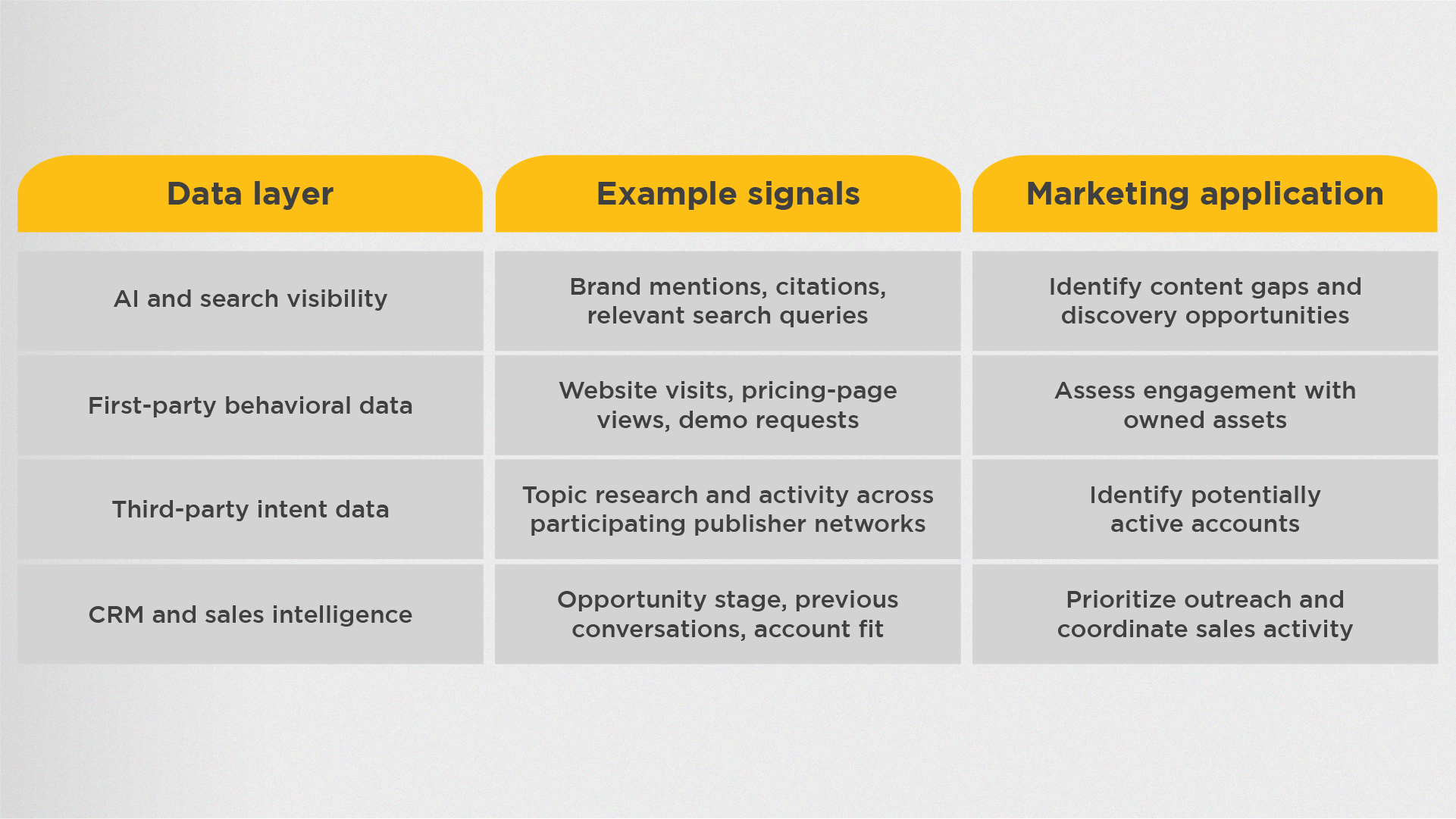
The real value comes from combining these sources, not looking at them separately.
For example, an account researching demand-generation solutions across industry publications may show preliminary interest. If several stakeholders subsequently visit a service page, download a relevant guide, and request a demonstration, the combined evidence supports a stronger buying-intent assessment.
But each signal needs context. One website visit or content download might just mean research, learning, or competitor analysis, not necessarily an immediate plan to buy.
Good B2B intent marketing services should assess signal quality, recency and frequency, account fit, and consistency across channels.
4. Why Account-Level Intent Detection Matters More in AI-Assisted Buying
Enterprise purchases rarely depend on a single decision-maker. Marketing leaders, technology teams, procurement professionals, finance stakeholders, and end users may investigate different aspects of the same solution.
AI search can support each stakeholder’s research independently. One person might explore implementation requirements, another may compare vendors, and a third may investigate pricing and security.
This creates a measurement challenge: individual interactions may appear disconnected even when they relate to the same organizational buying process.
The 2025 6sense B2B Buyer Experience Report, based on research involving nearly 4,000 B2B buyers globally, found that 95% of the time, the winning vendor was already on the buyer’s initial shortlist. It also reported that buyers favored the vendor in four out of five deals before engaging with sales.
These findings show why it’s important to influence buyers before they talk to sales.
Account-level intent detection can help businesses:
-
Identify organizations demonstrating relevant research activity.
-
Connect multiple observable engagement signals to the same account.
-
Prioritize accounts that match the ideal customer profile.
-
Identify content requirements across different stakeholder roles.
-
Coordinate marketing and sales engagement around account readiness.
A good account-prioritisation model combines firmographic fit, behavioral engagement, topic relevance, signal recency, and buying-group coverage.
For instance, an organization that fits the ideal customer profile and repeatedly engages with several relevant topics may warrant closer attention than an account that generates a large volume of unrelated website visits.
The goal isn’t to call every active account sales-ready. It’s to make prioritization based on real evidence.
5. How AI Search Optimization Supports Intent Marketing
If buyers use AI tools to find vendors, businesses need to ensure their expertise and capabilities show up clearly across the right discovery channels.
That’s why search optimization supports intent marketing. When a business shares clear, helpful information about its services, how they work, use cases, and what makes them different, buyers and search systems have more to work with.
Google’s official guidance on generative AI search, published in 2026, continues to emphasize helpful content, technical accessibility, original information, and established SEO fundamentals. It does not promise that special AI optimization techniques will guarantee inclusion in AI-generated answers.
B2B marketers should focus on the following actions.
Develop problem-led content. Create detailed resources addressing the operational challenges that prospective buyers want to solve.
Publish credible comparisons. Explain the differences between solutions, approaches, and service models using consistent evaluation criteria.
Demonstrate expertise. Support claims with original research, case studies, technical documentation, and verifiable evidence.
Strengthen external credibility. Maintain accurate company information across relevant industry publications, professional communities, and review platforms.
Connect content with intent signals. Use engagement with comparison guides, pricing information, and solution-specific resources to qualify leads.
These steps help ensure your content matches the questions buyers ask as they research and compare options.
6. Turning Intent Insights into Actionable Campaigns
Intent data isn’t useful unless you use the insights to guide your marketing decisions.
A practical framework should link data collection, interpretation, prioritization, and action.
Step 1: Detect relevant signals
Monitor available search visibility, first-party engagement, publisher activity, CRM interactions, and other permitted intent sources.
Step 2: Interpret the context
Evaluate topic relevance, account fit, signal recency, stakeholder activity, and likely buying-stage requirements.
Step 3: Prioritize accounts
Rank accounts using a defined scoring framework and identify those requiring additional nurturing or sales assessment.
Step 4: Activate relevant engagement
Deliver appropriate content, personalize outreach, and coordinate sales follow-up according to account readiness.
Step 5: Measure and refine
Compare qualified conversion rates, opportunity creation, pipeline velocity, and revenue contribution to improve the model.
For example, a technology company might identify an account researching customer data platforms and marketing automation. Instead of immediately sending a sales email, the marketing team could deliver a relevant integration guide, assess subsequent engagement, and coordinate outreach if stronger qualification signals emerge.
This way, intent insights help decision-making instead of being isolated alerts.
7. Measuring the Performance of AI-Driven Intent Marketing
AI search visibility and buyer intent detection need different ways to measure success. Visibility shows if a brand can be found, while intent metrics show if that interest leads to real opportunities.
Key performance indicators should include:
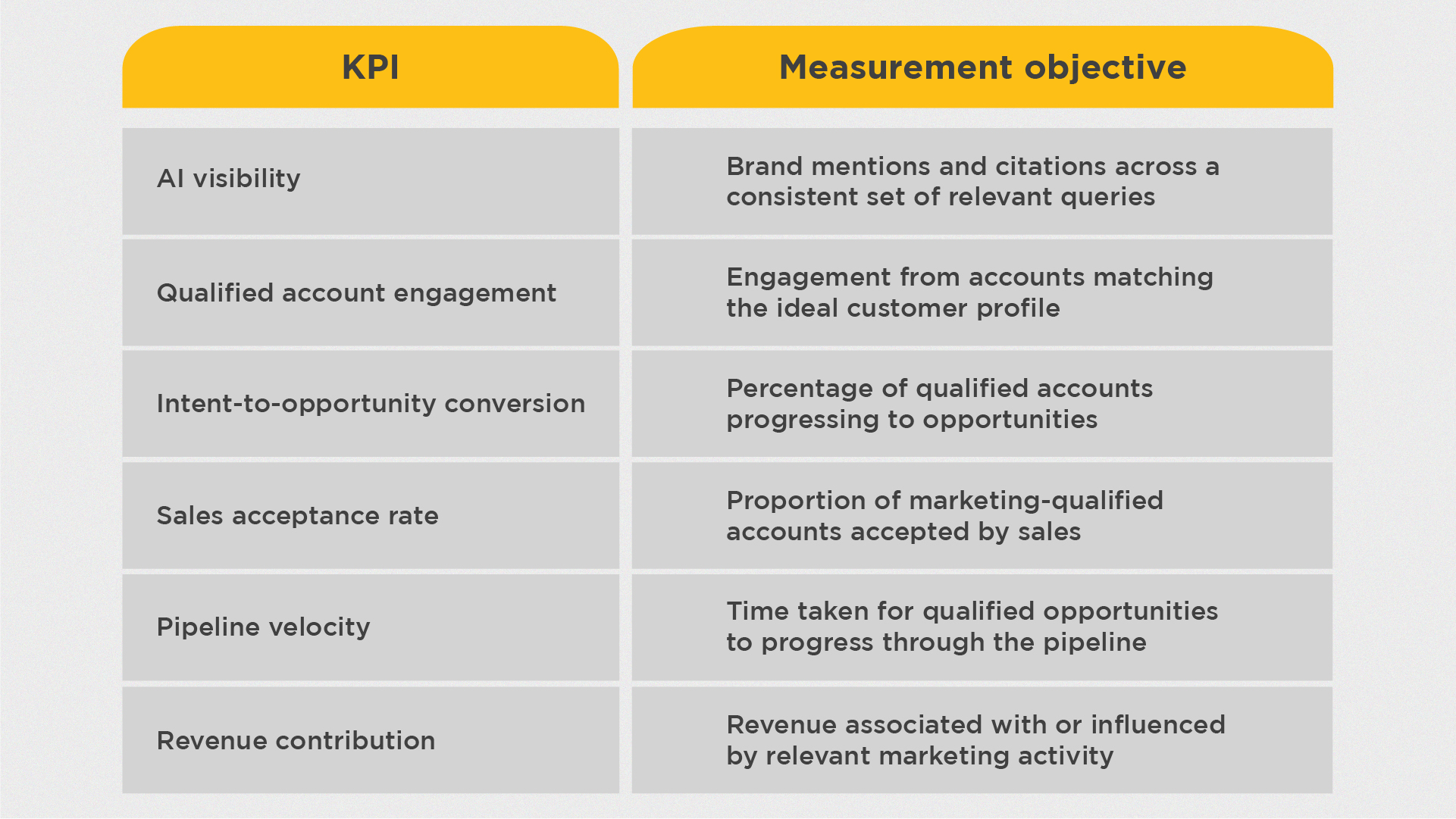
Track these metrics over time and compare them to your baseline. When you can, use controlled comparisons or account-level holdout groups to see what impact your campaigns really have.
AI visibility metrics have limits. Responses change by platform and query, and some AI-assisted discovery can’t be linked to a website session. So, citation frequency isn’t a direct replacement for measuring lead quality or revenue.
Data governance is equally important. Collect and use behavioral information in accordance with applicable privacy requirements, platform policies, consent obligations, and contractual restrictions.
Conclusion
AI search is changing how B2B buyers find vendors, compare solutions, and decide what to buy. As more research happens through AI tools, search engines, review sites, and professional groups, traditional lead-generation signals only show part of the picture.
Businesses need to link discoverability with real behavioral evidence, account insights, and meaningful engagement. By combining these, marketing teams can distinguish general interest from real buying signals and prioritize more effectively.
By integrating AI search visibility with intent marketing services, organizations can build more informed targeting strategies. Effective B2B intent marketing services can further connect account prioritization, personalized campaigns, and sales coordination, while data-driven intent data marketing helps measure how these activities contribute to qualified pipeline and revenue.
Competitive advantage won’t come from collecting the most signals, but from understanding the right ones in context and acting on them quickly and effectively.

Add a Comment