
Your CRM knows what happened. Your analytics platform knows what is happening. But what if your B2B data could tell you what is likely to happen next?
That is the real promise of predictive analytics.
Every B2B organization sits on thousands of data points: website visits, content downloads, email interactions, search behavior, CRM activity, firmographic information, intent signals and sales conversations. Yet much of this data is still used to create reports about the past.
A campaign generated 500 leads.
An account visited the pricing page.
A prospect attended a webinar.
An opportunity moved to the next stage.
Useful? Absolutely.
But these insights become considerably more valuable when connected to a bigger question:
What does this behavior tell us about what happens next?
Predictive analytics applies statistical modelling and machine learning to historical and real-time data to identify patterns associated with future outcomes. For B2B marketers, this can mean identifying accounts that may enter a buying cycle, leads with a higher probability of conversion, customers showing churn signals or campaigns likely to contribute to pipeline.
This is where data driven b2b marketing moves beyond dashboards and enters the territory of foresight.
From “What Happened?” to “What Happens Next?”
Traditional marketing analytics is largely retrospective.
Consider a typical monthly report:
10,000 website visitors → 1,200 leads → 250 MQLs → 60 opportunities
The numbers tell a story about performance. They do not necessarily tell the marketing team where the next 60 opportunities could come from.
Predictive analytics changes the question.
Instead of simply measuring activity, it searches for relationships between past behavior and known outcomes.
For example, historical data might reveal that accounts which:
-
return to the website multiple times within 30 days,
-
consume product-focused content,
-
have multiple engaged stakeholders,
-
match a particular ICP profile, and
-
demonstrate relevant intent signals
are more frequently associated with opportunity creation.
A predictive model can identify other accounts exhibiting similar patterns.
The result is not a crystal ball. It is a probability-based view of what could happen next.
And that distinction matters.
Predictive analytics does not predict buyers. It predicts patterns of behavior based on evidence.
The Predictive Analytics Engine: How It Actually Works
Behind the polished dashboard is a technical process involving data collection, preparation, modelling and continuous validation.
1. Start With the Right Data
More data does not automatically mean better predictions.
A B2B predictive model may draw from:
First-party data: CRM records, website activity, email engagement, form submissions, product usage and customer interactions.
Firmographic data: Industry, company size, revenue range, geography and organizational structure.
Techno graphic data: Technologies used by an organization and potential technology changes.
Intent data: Signals indicating increased interest in specific subjects, solutions or categories.
Engagement data: Content consumption, event attendance, campaign responses and account-level interactions.
The objective is to combine these signals into a meaningful representation of the buyer or account.
2. Turn Raw Activity Into Predictive Features
This is where predictive analytics becomes more sophisticated than conventional reporting.
A CRM may tell you that an account visited your website eight times.
A predictive model can turn that raw number into multiple features:
-
Visit frequency
-
Recency of engagement
-
Change in engagement over time
-
Number of high-intent pages viewed
-
Content category consumed
-
Number of stakeholders engaging
-
Engagement velocity
That last concept is particularly interesting.
Engagement velocity measures how quickly activity is increasing or decreasing.
An account that visited your website twice last month and 12 times this month may represent a very different situation from an account that has visited 12 times every month for a year.
Both have 12 visits.
Their trajectories are different.
Predictive models are designed to detect these kinds of patterns.
The Hidden Signal: Behavioral Change
One of the biggest advantages of predictive analytics is that it can detect changes in behavior, not just individual actions.
Imagine an enterprise account that has shown minimal engagement for six months.
Then, within three weeks:
-
three employees download technical content,
-
a senior stakeholder attends a webinar,
-
the account revisits a solution page,
-
multiple people interact with email campaigns, and
-
intent activity around the relevant category increases.
None of these signals alone necessarily indicates purchase intent.
Together, however, they represent a behavioral shift.
A predictive model can recognize that this combination resembles patterns previously associated with opportunities.
This gives marketers something more useful than another engagement report:
A potential early-warning signal for a changing buying journey.
Predictive Lead Scoring: Stop Treating Every Lead the Same
Traditional lead scoring often relies on fixed rules.
For example:
Email click = +5
Webinar attendance = +10
Job title matches ICP = +15
The problem is that these scores assume the same activity has the same value across every buyer.
Predictive scoring approaches the problem differently.
A model can analyze historical leads and identify which combinations of characteristics and behaviors have been associated with actual outcomes.
Perhaps webinar attendance alone has little predictive value.
But webinar attendance + seniority + repeat website engagement + a specific firmographic profile may have a strong relationship with opportunity creation.
The model can therefore assign a probability based on the combination of signals, rather than simply adding points to a predefined score.
This allows sales teams to prioritize leads based on predicted propensity rather than raw activity.
From Lead Scoring to Account Foresight
B2B buying is rarely a one-person decision.
A prospect may be researching a solution while procurement, IT, finance and senior leadership are evaluating different aspects of the purchase.
That makes account-level predictive analytics particularly valuable.
Instead of asking:
“Is this contact ready to talk to sales?”
marketers can ask:
“Is this account showing signs of entering a buying cycle?”
An account-level model can combine:
Multiple stakeholder interactions + firmographic fit + intent signals + engagement trajectory + historical patterns
to estimate account-level propensity.
This can help marketing identify accounts that may warrant increased attention before an obvious conversion event occurs.
For account-based strategies, this creates a bridge between ABM targeting and predictive intelligence.
Predicting Pipeline Before It Becomes Pipeline
One of the most interesting applications of predictive analytics is its ability to identify potential pipeline before an opportunity formally exists in the CRM.
Consider two accounts.
Account A has downloaded one eBook and filled in a form.
Account B has no form fill but has shown increasing engagement across several stakeholders, consumed solution-focused content and demonstrated relevant intent activity.
A traditional lead-generation dashboard may favor Account A because it has produced an identifiable lead.
A predictive system can examine the broader behavioral context and potentially flag Account B as a higher-propensity account.
This changes the role of marketing.
Instead of waiting for buyers to raise their hands, teams can use behavioral evidence to identify where buying activity may be developing.
Predictive Analytics Can Also Find Risk
Foresight is not only about finding opportunities.
It can also identify where performance may deteriorate.
Predictive models can analyze customer behavior to identify potential churn patterns using variables such as:
-
Declining product usage
-
Reduced engagement
-
Lower support interaction
-
Contract milestones
-
Changes in stakeholder activity
-
Declining campaign participation
Similarly, marketing teams can use predictive analytics to identify potential campaign under-performance.
If current engagement patterns differ significantly from historical campaigns that successfully generated pipeline, teams can intervene earlier rather than waiting for end-of-quarter reporting.
Prediction turns hindsight into an early-warning system.
What Makes Predictive Analytics Different From a Dashboard?
A dashboard answers:
“What is happening?”
Predictive analytics asks:
“What does the current pattern suggest could happen next?”
That difference may sound subtle, but it changes how teams operate.
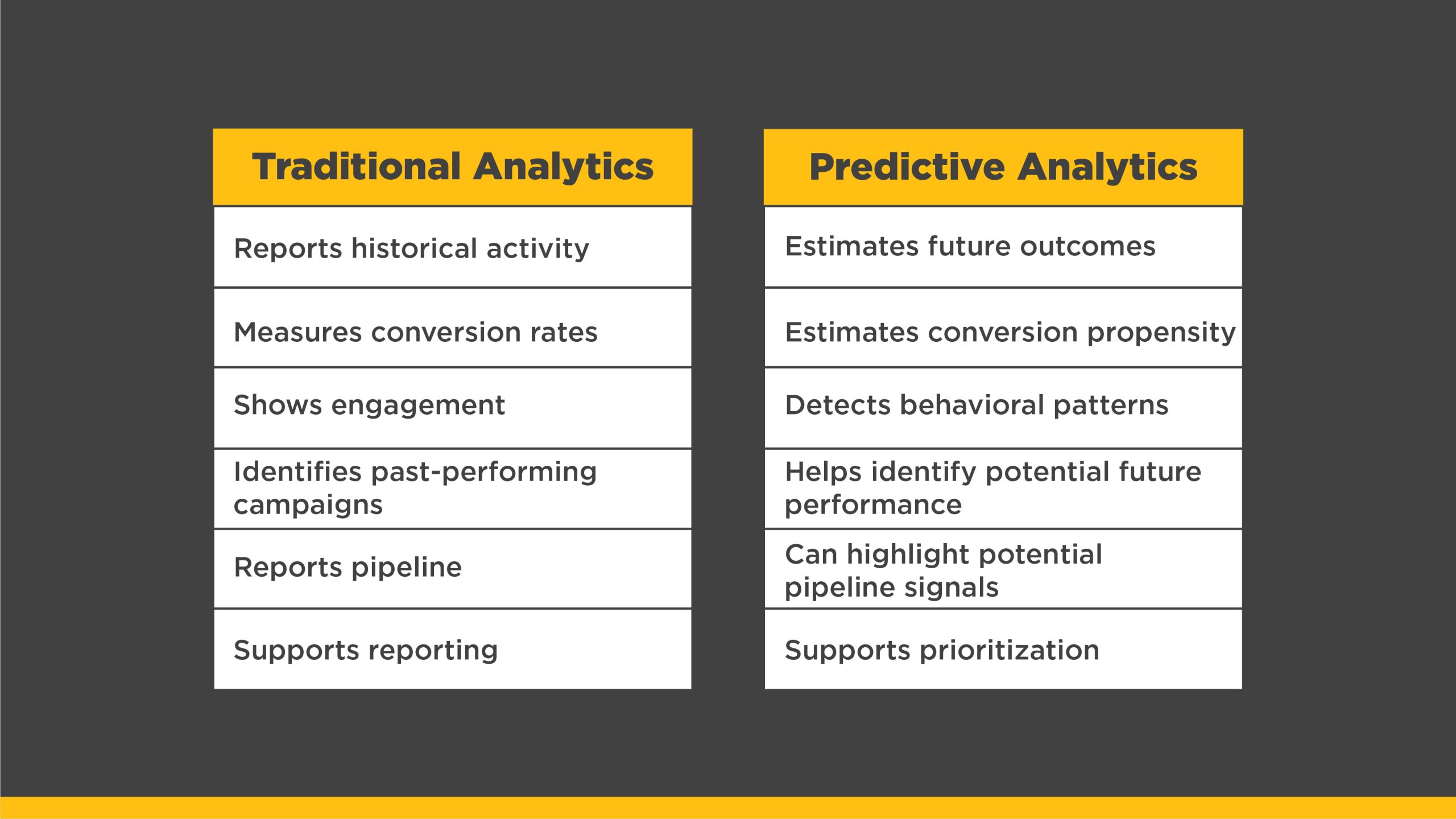
For organizations building a data driven b2b marketing engine, both are necessary.
You still need accurate reporting.
But reporting tells you where you have been.
Predictive analytics helps you navigate where you may be going.
The Machine Learning Layer
Machine learning can make predictive analytics significantly more powerful by identifying relationships across large datasets.
Depending on the problem, organizations may use algorithms such as:
-
Logistic regression
-
Decision trees
-
Random forests
-
Gradient boosting
-
Neural networks
-
Time-series models
For example, a classification model could estimate whether an account is likely to become an opportunity within a specific period.
A regression model could estimate potential revenue value.
A time-series model could identify trends in demand or engagement.
The choice of model should depend on the business problem rather than the desire to use the most complex algorithm available.
A sophisticated model is not automatically a useful model.
The Feedback Loop That Makes Predictions Smarter
Predictive analytics should not be treated as a one-time implementation.
The strongest systems operate as a continuous learning loop:
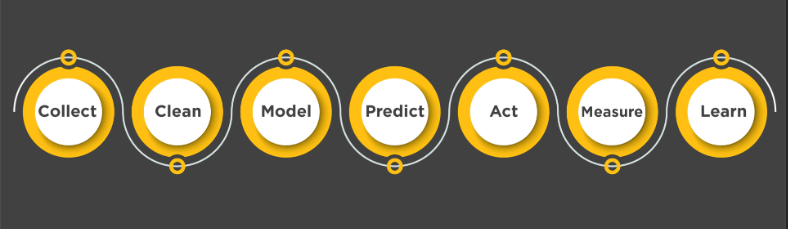
Suppose a model identifies 100 accounts as having high opportunity propensity.
Over time, the organization can compare those predictions with actual outcomes.
How many entered the sales pipeline?
How many converted?
Which signals were present?
Where did the model overestimate?
Where did it miss?
These outcomes can then be incorporated into future model development.
This creates an important principle for data driven b2b marketing:
The value of predictive analytics grows when predictions are connected to measurable business outcomes.
The Biggest Challenge: Bad Data Still Produces Bad Predictions
Predictive analytics cannot magically correct poor data.
Duplicate CRM records, missing firmographic information, outdated contacts, inconsistent account structures and fragmented platforms can all weaken model performance.
There is also the problem of model drift.
Buyer behavior changes.
Markets change.
Products change.
Buying committees change.
A model trained on yesterday’s behavior may gradually become less representative of today’s market.
Therefore, predictive systems need ongoing monitoring, validation and retraining.
Marketing teams should track not only model accuracy but also whether predictions continue to translate into meaningful business outcomes.
Turning Foresight Into Action
The ultimate objective is not to build an impressive predictive model.
It is to make better-informed marketing decisions.
A practical workflow could look like this:
Detect: Identify accounts or leads showing high predicted propensity.
Prioritize: Compare propensity with ICP fit and potential business value.
Personalise: Adapt content, messaging and outreach to the buyer’s context.
Activate: Coordinate marketing and sales engagement.
Measure: Track downstream outcomes rather than clicks alone.
Learn: Feed actual results back into the predictive system.
This transforms predictive analytics from a data-science project into an operating layer for marketing.
The Future of B2B Marketing Is Not More Data. It Is Better Foresight.
B2B organizations already have vast amounts of information.
The challenge is no longer simply collecting more data. It is understanding which signals matter, how they interact and what they may indicate about future behavior.
Predictive analytics provides that missing layer.
It connects historical outcomes with current signals to help marketers identify patterns before they become obvious outcomes.
The progression is straightforward:
Descriptive analytics: What happened?
Diagnostic analytics: Why did it happen?
Predictive analytics: What could happen next?
Prescriptive analytics: What action should we consider?
That progression is reshaping data driven b2b marketing from a reporting discipline into a more forward-looking decision system.
The organizations that extract the most value from predictive analytics will not necessarily be those with the largest datasets. They will be those that connect clean data, meaningful signals, reliable models and real business decisions into one continuous feedback loop.
Because in modern B2B marketing, the competitive advantage is not simply knowing what your buyers did yesterday.
It is recognizing the signals that could matter tomorrow, early enough to act on them.
This version uses a stronger narrative hook, behavioural-change examples, predictive lead/account scoring, technical modelling concepts, tables and a clearer “data → prediction → action” storyline, while keeping the target keyword natural.

Add a Comment