
B2B buyers now expect personalized and relevant interactions at every stage of their purchasing journey. Businesses use customer intelligence for targeted emails, account-based ads, and content recommendations to make these experiences more meaningful. But to deliver this at scale, companies need more than just advanced marketing tools, they need connected, accurate, and well-managed data.
Even with more investment in AI, customer data platforms, and marketing automation, many companies still face issues with disconnected data and changing privacy rules. These problems can limit how well hyper-personalisation works in B2B, making it harder to deliver consistent messages and keep buyer trust.
To overcome these challenges, companies need an approach that brings together data governance, smart technology, privacy-focused strategies, and useful buyer insights.
1. Understanding the Impact of Data Silos on B2B Personalization
Data silos happen when customer information is spread across separate systems like CRM platforms, marketing automation tools, sales databases, website analytics, and third-party data providers. Each system tracks a different part of buyer behavior, but without integration, marketers can’t create a complete customer profile.
Salesforce’s 2026 data and analytics research shows that the average company uses 897 applications, but only 29% are connected. About 19% of enterprise data is siloed, inaccessible, or unusable. This fragmentation makes it hard to get the insights needed for effective AI-powered personalization.
Salesforce
For B2B organizations, the consequences include:
- Inconsistent customer profiles: Different platforms maintain conflicting information about the same account or contact.
- Limited buyer visibility: Marketing teams cannot connect website visits, content engagement, email interactions and sales conversations.
- Inefficient campaign targeting: Outdated or incomplete information reduces the accuracy of audience segmentation.
- Poor lead prioritization: Disconnected behavioral and intent signals make it difficult to identify sales-ready prospects.
Because of this, businesses need a connected data setup before they can scale their personalization efforts.
2. Why Privacy Challenges Are Increasing Alongside Personalization
Hyper-personalisation needs detailed information about business accounts, decision-makers, professional interests, and digital engagement. But collecting and using this data without clear transparency can lead to privacy concerns.
This challenge is even more important now that organizations use AI more often to analyze prospect behavior and automate personalized communication.
Salesforce’s State of the AI Connected Customer research found that 71% of customers are more protective of their personal information, and 64% think companies handle data carelessly. This shows the need to balance relevant experiences with responsible data management.
Salesforce
Privacy challenges in B2B marketing commonly include:
- Collecting prospect information without clearly communicating its intended use.
- Sharing personal information between publishers, marketing platforms and external vendors without appropriate controls.
- Retaining outdated contact information beyond necessary periods.
- Using AI-generated insights without sufficient transparency or human oversight.
- Managing data access and deletion requests across multiple systems.
These risks can hurt buyer confidence and make personalized marketing campaigns less effective.
3. Strategies to Overcome Data Silos in B2B Hyper-Personalisation
A. Build a Unified Customer Data Infrastructure
Bringing together CRM systems, customer data platforms (CDPs), marketing automation tools, and analytics gives a complete view of customer interactions.
A unified setup lets marketers link account-level information with individual engagement. For example, combining website activity, email responses, content downloads, and sales interactions helps show where an account is in its buying journey.
Businesses should also set up standard data fields, shared account identifiers, and automated syncing to reduce inconsistencies.
B. Prioritize First-Party Data Collection
First-party data gives valuable insights into buyer preferences through direct interactions like website visits, webinar sign-ups, newsletter subscriptions, and content downloads.
Instead of relying only on outside data sources, marketers should find ways to encourage prospects to share relevant information willingly.
Progressive profiling gathers more details over several interactions, rather than asking for a lot of information all at once. This makes data more accurate and the experience less intrusive.
C. Implement AI-Powered Data Enrichment and Identity Resolution
AI-powered data management tools can find duplicate records, spot inconsistencies, and add useful business information to customer profiles.
Identity resolution connects different interactions to the same prospect or account, helping marketers see cross-channel engagement more clearly.
For example, if several employees from the same company engage with related content, account-level insights can show shared buying interest. This helps marketing teams personalize campaigns based on the organisation’s needs instead of treating each interaction separately.
D. Integrate Intent Data with Behavioral Insights
Combining buyer intent signals with first-party engagement data gives a fuller picture of purchasing behavior.
For example, if someone visits solution-specific pages often, joins technical webinars, and downloads product comparisons, it can show growing interest.
When these signals are used in lead scoring and account prioritization, marketing teams can share content based on how ready the buyer is, instead of just using basic demographic segments.
4. Establish Privacy-First Data Governance Frameworks
Strong governance is needed to make sure personal information is collected, processed, stored, and shared responsibly when integrating data.
B2B organizations working in different markets need to know the privacy rules that apply to their audiences and business activities.
For example, the General Data Protection Regulation (GDPR) establishes requirements for processing personal data in the European Economic Area. At the same time, US businesses may need to comply with applicable state privacy laws, including the California Consumer Privacy Act (CCPA), as amended by the California Privacy Rights Act (CPRA).
The IAPP’s October 2025 report found that 19 US states have broad consumer privacy laws, showing how complex the rules are for organizations handling customer information.
IAPP
Businesses should implement the following measures:
- Consent management: Maintain appropriate records of consent and applicable marketing preferences.
- Data minimization: Collect only the information necessary for defined business purposes.
- Access controls: Limit access to sensitive customer information to authorized employees and systems.
- Data retention policies: Establish clear timelines for reviewing and deleting unnecessary records.
- Vendor governance: Evaluate the data protection practices of publishers, technology providers and external marketing partners.
These steps help organizations stay accountable and build personalized experiences based on responsible data use.
5. Balance AI Automation with Human Oversight
Artificial intelligence lets marketers analyze large datasets, spot patterns, and create personalized content at scale. But if the data is wrong or the messages feel too intrusive, automated personalization can stop working well.
A 2025 Gartner survey found that personalized marketing generated negative experiences for 53% of surveyed customers. These individuals were 3.2 times more likely to regret a purchase and 44% less likely to purchase again. The findings demonstrate that personalization must provide genuine value rather than simply increasing message frequency.
To address this challenge, enterprises should:
- Use AI to identify relevant content preferences and engagement patterns.
- Apply human review to sensitive or high-impact personalized communications.
- Monitor campaign frequency to prevent excessive outreach.
- Regularly validate the accuracy of AI-generated customer insights.
- Measure engagement quality rather than relying exclusively on clicks and impressions.
Using both automation and human insight helps keep personalized communication relevant, contextual, and in line with what buyers expect.
6. Measure the Effectiveness of Privacy-First Hyper-Personalisation
Setting up data integration and privacy controls is just the beginning. Organizations need to keep checking if these efforts actually improve marketing performance.
The following metrics can help assess campaign effectiveness:
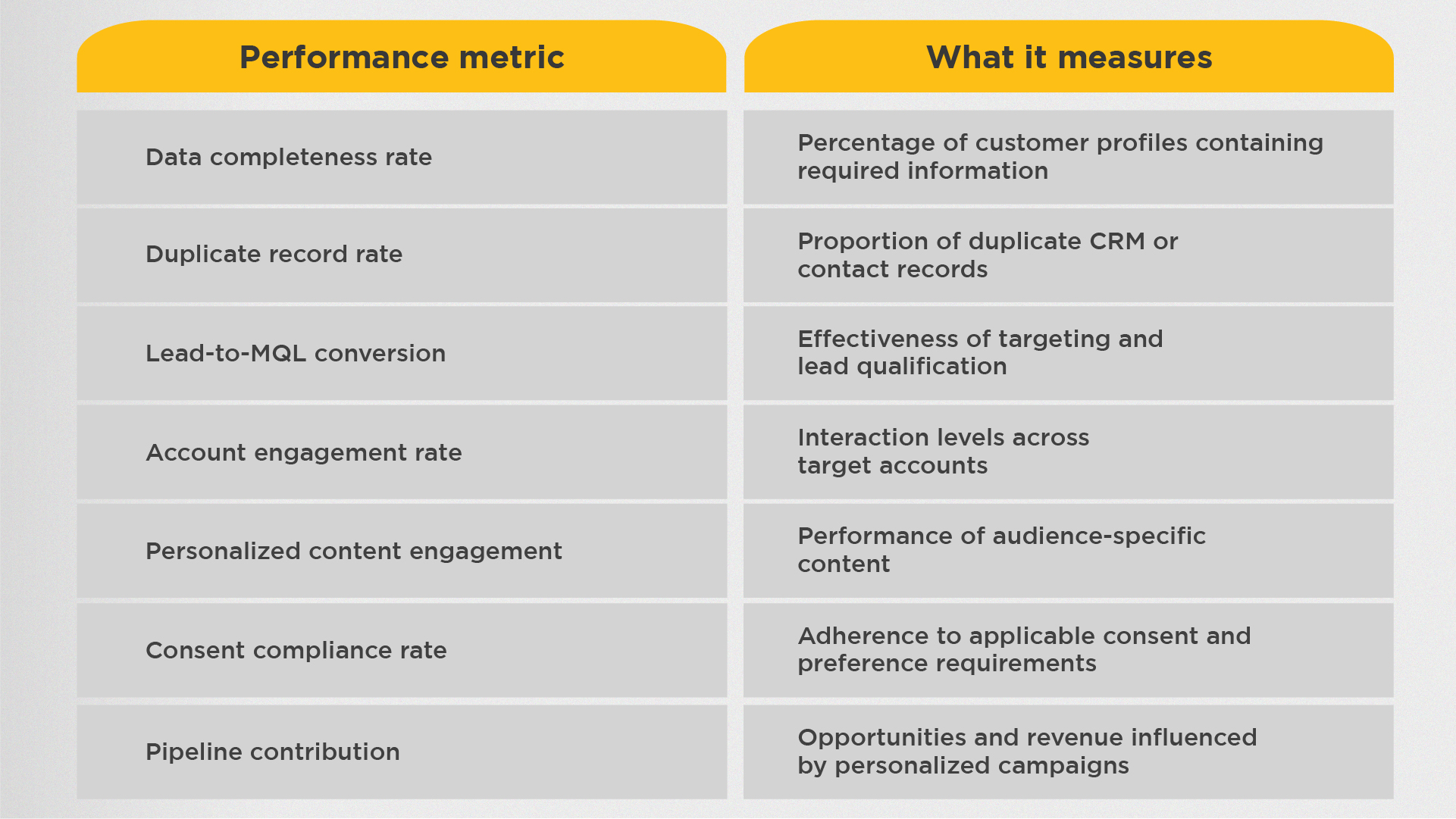
By tracking these indicators with integrated dashboards, marketing teams can spot data gaps, improve segmentation, and make campaigns work better.
Conclusion
To build sustainable B2B marketing strategies, companies need to address data silos and privacy challenges. As more businesses use advanced analytics and AI, personalization will rely more on having high-quality, accessible, and responsibly managed customer data.
To achieve effective hyper-personalisation in B2B, it takes more than just linking marketing platforms. Companies also need a unified data system, reliable buyer insights, clear privacy policies, and ongoing performance tracking.
When organizations bring these elements together, they can offer more relevant experiences to buyers, boost account engagement, and get better lead generation results while still protecting customer trust.

Add a Comment